Recently, the first China Radio and Television
Conference Director Forum was held in Beijing. The Guangdong Radio and
Television Bureau demonstrated its accelerated practice in the development of
the UHD industry, which is behind the country's continued promotion of the UHD
industry. The Guangdong Radio and Television Bureau not only issued the
"2025 UHD TV Development Award and Subsidy Implementation Plan", but
also invested 215 million yuan in the past five years to help the development
of UHD TV. At the same time, the State Administration of Radio and Television
plans to launch 13 new UHD channels by the end of 2025, when the total number
of UHD channels will exceed 20, and online audio-visual platforms such as
iQiyi, Youku, and Tencent will also make UHD programs the mainstream.
The rapid development of UHD TV technology has
benefited from strong support at the national level. The UHD TV award and
subsidy policy has not only improved the supply capacity of 4K/8K content, but
also promoted technological innovation in the LED display industry, especially
in virtual shooting, COB packaging and MIP display technology.
The physical resolution of UHD TV is 4 times that of
full HD, and the picture is delicate and realistic, bringing a new experience
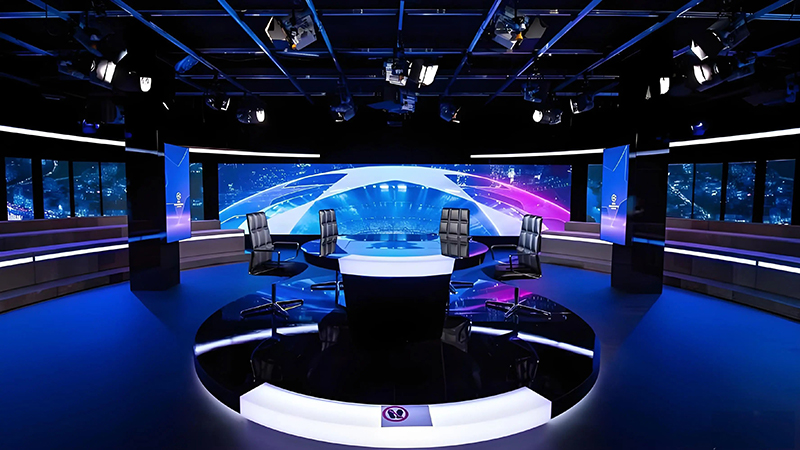
to users and new opportunities to the LED display industry. Virtual shooting
technology uses high-precision LED display screens and advanced rendering
technology to simulate realistic virtual scenes to meet the high requirements
of ultra-high-definition content production. The reward and subsidy policy
reduces the cost of ultra-high-definition content production, allowing more producers
to adopt LED virtual shooting technology and improve production efficiency.
At the same time, the development of
ultra-high-definition televisions has also promoted the upgrading of COB
packaging technology. As an advanced LED display packaging technology, COB
packaging technology improves the integration and reliability of LED display
screens and significantly improves the display effect. The implementation of
the reward and subsidy policy has enabled LED display companies to pay more
attention to technological innovation to meet the demand for display technology
for ultra-high-definition televisions. In addition, the policy has also
promoted close cooperation between upstream and downstream companies in the LED
display industry chain, laying a solid foundation for the widespread
application of COB packaging technology in the field of ultra-high-definition
televisions.
As one of the cutting-edge technologies in the LED
display industry, MIP display technology has also achieved accelerated market
popularization and commercialization under the promotion of the
ultra-high-definition television reward and subsidy policy. As consumers pay
more attention to ultra-high-definition display products, MIP display
technology, as a key component of ultra-high-definition display technology, has
been more widely used. This acceleration of market popularization and
commercialization provides a broader market space and development opportunities
for the development of MIP display technology.
However, facing the development opportunities brought
by the UHD TV subsidy policy, LED display screen companies also face many
challenges. The market competition is fierce, and companies need to improve
product quality and service levels to enhance customer satisfaction and
loyalty. At the same time, they need to strengthen marketing and brand
building, enhance brand awareness and reputation, and attract more customers.
In short, the implementation of the UHD TV subsidy
policy has had a profound impact on the development of UHD content production
and LED display technology. The policy has promoted the development of UHD
content production towards higher resolution and higher picture quality, and
also provided a rare opportunity for the development of the LED display
industry. LED display screen companies need to actively respond to challenges,
take effective measures, seize this opportunity, and achieve sustainable development.

 OE P1.9/P2.6/P2.9Item Number: P1.9/P2.6/P2.9
 OH P3.9/P4.8OH P3.9/P4.8
 OB Plus P5/P6/P10Outdoor LED Screen P5.7/P6.67/P8/P10 Brightness:5500-10000nits Cabinet size:960W×960H mm
 Indoor TransparentCrytal Series Model:P5/P6.25/P8/P10etc.
 Outdoor MeshOutdoor Mesh Model:P3.9-7.8/P15-15/P15-31etc.
 CV P1.2/P1.5/P1.8640*480mm cabinet size, Fine pitch high cost performance
 AD P1.9/P2.6/P2.9Indoor LED Screen P1.5/P1.9/P2.6/P3.9 Brightness:600-1000nits Cabinet size:500W×250H/750W×250H/1000W×250H mm


