The Sphere, an arena for music and entertainment,
stands in Paradise, Nevada, USA, to the east of the renowned Las Vegas Strip.The
project was announced by Madison Square Garden Company (MSG) in 2018 as MSG
Sphere. The spherical theater inside is known for its immersive audio and video
capabilities.
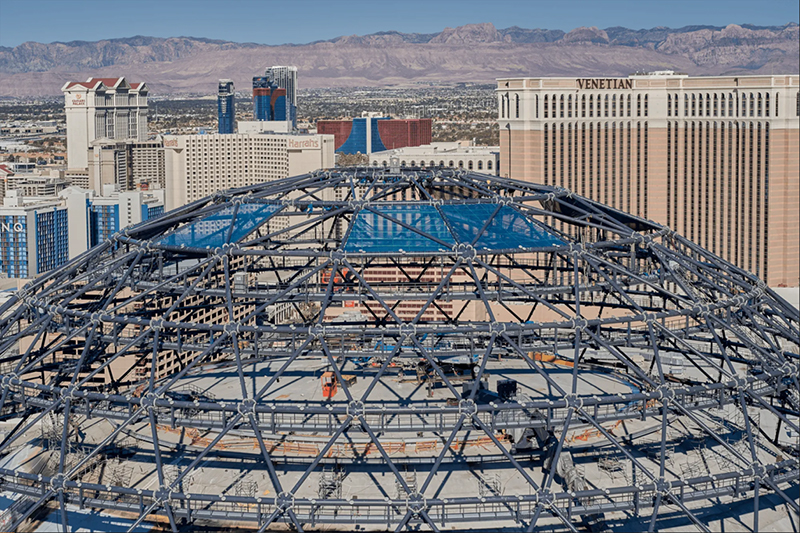
The Sphere was designed by Populous and the project
was expected to cost $1.2 billion in 2018. Due to design changes, supply chain
crises, and inflation, it ended up costing $2.3 billion, making it the most
expensive entertainment venue in Las Vegas history. The Sphere was inaugurated
on September 29th, 2023, and subsequently, the Irish rock band U2 embarked on a
40-concert residency there. Director Darren Aronofsky's documentary Postcards
from Earth was released on October 6, 2023. The venue is primarily used to host
award ceremonies and concerts, as well as other entertainment events. While its
design is not suited to the arena layout of traditional sports such as
basketball and ice hockey, it can host ring sports such as boxing and mixed
martial arts, as well as e-sports tournaments.
Construction of the Sphere
The venue is 112 meters tall and 157 meters wide at
its widest point. It is the largest spherical building in the world, covering
an area of 81,300 square meters.
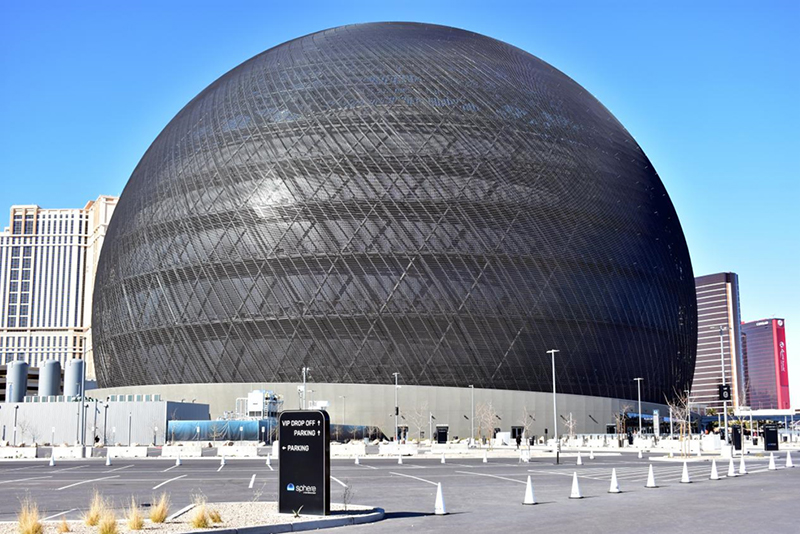
The dome's roof necessitated the use of 3,000 tons of
steel. In March 2021, the roof began to take shape and workers began to install
32 trusses, each weighing 100 tons. In May 2021, the trusses were half
installed and the crane had to move to the south side of the venue to install
the remaining parts.
The dome was capped on June 18, 2021, and construction
of the outer dome frame built around the dome was also underway. The outer dome
frame is made of LED light panels and is 30% taller than the dome, which can be
seen from miles away. Construction work on the interior of the sphere began in
August 2021.
Once the roof steel frame was completed, 4,600 cubic
meters of concrete were pumped onto the roof. This created a concrete layer
that was 10 inches (250 mm) thick and weighed about 10,000 tons. The roof was
completed in October 2021. Workers then turned their attention to the 730-ton
steel internal frame that supports the LED screens and sound system.
Construction of the internal frame continued until 2022.
On May 24, 2022, the outer dome was capped for the
second time. The internal and external LED screens were then installed. The
latter was first lit up during the Independence Day celebrations on July 4,
2023. The sphere quickly became popular for its image display.
How many seats can the sphere hold at most
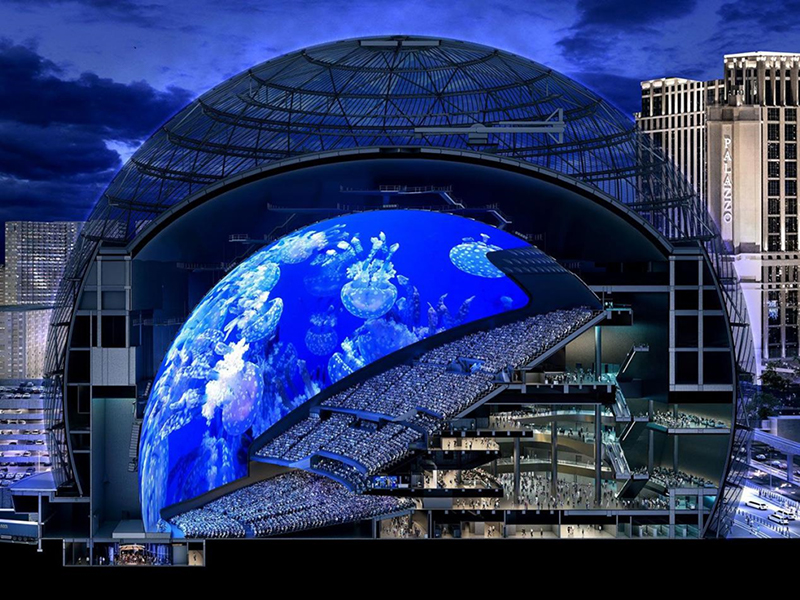
The sphere has 18,600 seats and can accommodate up to
20,000 people (when the stage is at its smallest). The seats do not surround
the entire sphere, but cover about 2/3 of the interior space, with the stage
occupying the rest. Because of the overhang of the second floor, the
approximately 800 seats below the lower level of the venue cannot view the
wraparound video screen.
Exterior Sphere Shell LED Display
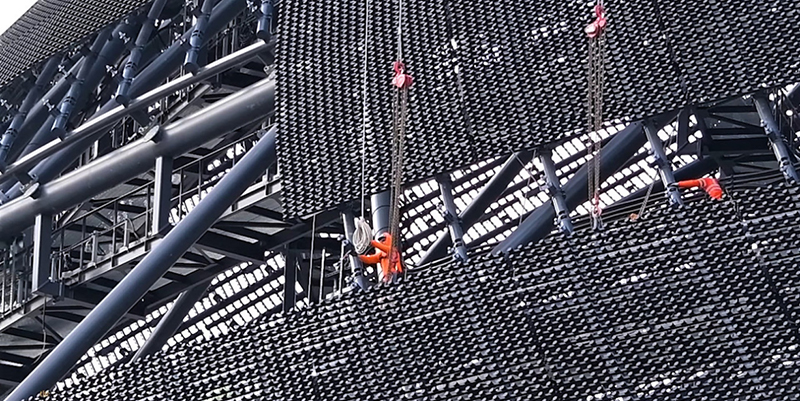
The sphere's outer shell is equipped with a 580,000
square foot (54,000 square meter) LED display designed by SACO Technology. It
was the largest display in the world at the time. It is composed of 1.23
million ice ball LEDs, each containing 48 diodes, spaced 8 inches (20 cm)
apart. It can be used for advertising.
Theater Interior Sphere LED Display
The theater is equipped with a 160,000 square foot
(15,000 square meter, larger than three football fields) LED screen that wraps
around the entire interior wall and ceiling. The screen was designed and
manufactured by SACO. According to Sphere Entertainment, it has a resolution of
16,000×16,000, which is
the highest resolution LED screen in the world at the time, with a resolution
82 times that of today's best HDTVs. The screen consists of 64,000 LED panels,
each managed by a printed circuit board housed within an aluminum frame, and
these panels come in 780 distinct geometric configurations. Due to its curved
shape and the tendency of pixels to disappear near the poles, the screen uses
adaptive pixel spacing. It is also designed to be acoustically transparent,
allowing sound from speakers installed behind the screen to pass through.
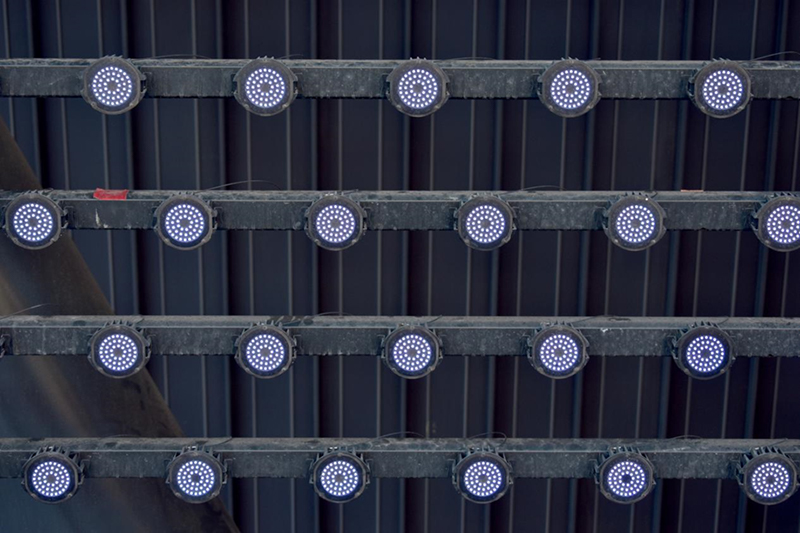
It should be clarified that although its resolution is
the largest in the world, its pixel density is not high due to its large
distribution area, that is, the clarity is not high. Its average pixel spacing
is only 9.5mm, which is equivalent to the domestic P9.5 transparent screen.
From the figure below, it can be seen that the LED screen has a large air
permeability (about >50%), which is more favorable for the sound
transmission of speakers arranged behind the LED screen.
The sound system of the theater
The sound system of the spherical theater was
completed by Holoplot, a German company, using a total of 167,000 speakers.
Holoplot uses 3D beamforming and wave field synthesis technology to provide
sound control similar to controlling light, bringing a consistent and clear
concert-level audio experience, so that every audience can enjoy a truly
excellent and personalized listening experience. The entire sound system can be
divided into three parts, covering the entire venue's sound reinforcement
system, surround speaker system, and immersive speaker system.
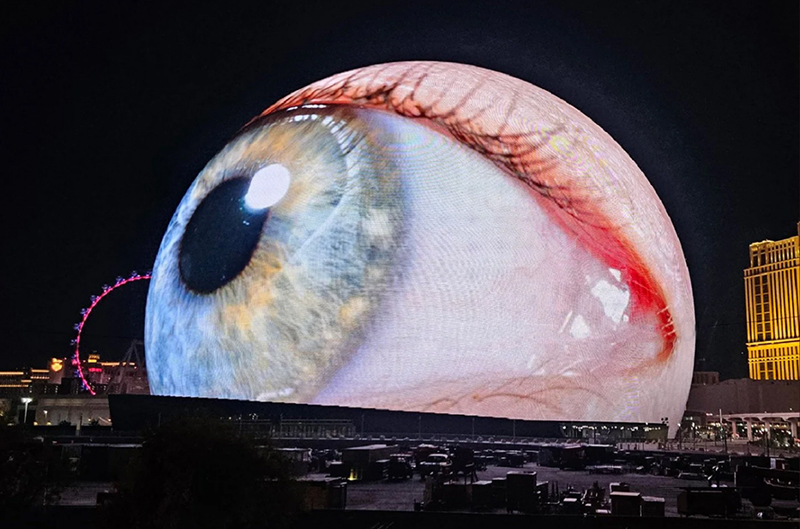
The LED display and sound system of the Las Vegas
Sphere, through the perfect integration of cutting-edge technology, have
jointly created a full-scale immersive experience space that integrates vision
and hearing, making every event an unforgettable sensory adventure.

 OE P1.9/P2.6/P2.9Item Number: P1.9/P2.6/P2.9
 OH P3.9/P4.8OH P3.9/P4.8
 OB Plus P5/P6/P10Outdoor LED Screen P5.7/P6.67/P8/P10 Brightness:5500-10000nits Cabinet size:960W×960H mm
 Indoor TransparentCrytal Series Model:P5/P6.25/P8/P10etc.
 Outdoor MeshOutdoor Mesh Model:P3.9-7.8/P15-15/P15-31etc.
 CV P1.2/P1.5/P1.8640*480mm cabinet size, Fine pitch high cost performance
 AD P1.9/P2.6/P2.9Indoor LED Screen P1.5/P1.9/P2.6/P3.9 Brightness:600-1000nits Cabinet size:500W×250H/750W×250H/1000W×250H mm


